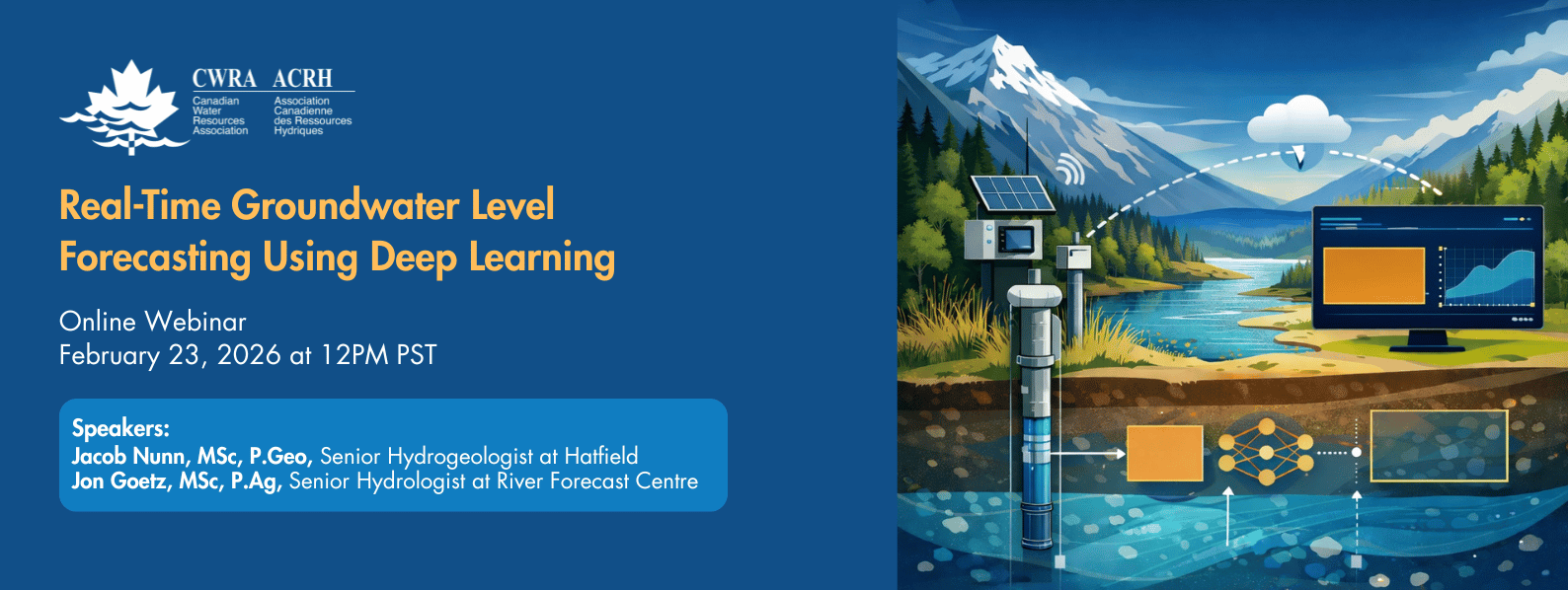

Feb 23, 2026: BC Branch: Real-Time Groundwater Level Forecasting Using Deep Learning applied in British Columbia
Date: Monday, Feb 23, 2026
Topic: Real-Time Groundwater Level Forecasting Using Deep Learning applied in British Columbia
Speaker: Jacob Nunn
Description:
A deep learning model using an Artificial Neural Network (ANN) was developed for real-time groundwater level forecasting for observation wells across the British Columbia Provincial Groundwater Observation Well Network (PGOWN). It integrates seamlessly with existing climate forecasts, incorporating 16-day deterministic forecasts and leveraging historical climate statistics to generate 7 to 90-day advance probabilistic groundwater level forecasts. The forecasting system is designed as an early warning tool for below-normal groundwater levels, supporting provincial efforts to anticipate and respond to potential drought conditions.
During development, the project tested various input hydroclimatic variables, model architectures, and different statistical and machine learning approaches across many of the province’s complex hydroclimatic and aquifer settings incorporating over 200 PGOWN wells and groundwater level forecasts were comprehensively tested . This comprehensive testing highlighted the intricate interactions between groundwater levels and predictor variables in both snowmelt and rainfall settings. The preferred ANN model demonstrates good performance in a variety of hydroclimatic settings (both rainfall and snowmelt dominated groundwater recharge regimes, including streamflow-driven recharge regimes), various aquifer types (unconsolidated, bedrock, confined, unconfined), and aquifers without and with various long-term groundwater levels trends or fluctuations, including highly developed aquifers like those in the Fraser Valley.